


 SELECT SCORE:

Before 2018, legal sports betting in the U.S. was basically a one-state show. If you weren’t in Nevada, you were either using an offshore site or betting under the table. The reason? A federal law called PASPA.
Short for the Professional and Amateur Sports Protection Act, PASPA made it illegal for most states to legalize or regulate sports betting. It didn’t ban you from placing a bet but it made sure your state couldn’t set up a legal way for you to do it.
Even though PASPA hasn’t been around since 2018, its shadow still looms over how sports betting works today. The law’s restrictions are why offshore sportsbooks got so popular, and why the current U.S. market is a patchwork of state-by-state rules instead of one national system.
This guide walks you through what PASPA actually did, how it ended, and why understanding it helps make sense of everything from state sports betting to the rise of offshore sportsbooks.
PASPA and the Rise of Legal Sports Betting
PASPA was a 1992 federal law that blocked most states from legalizing sports betting. It didn’t ban betting itself, but it stopped states from regulating or licensing it. That freeze lasted until 2018, when the Supreme Court struck it down in Murphy v. NCAA. Since then, states have been free to legalize sports betting on their own terms. PASPA’s fall explains why betting laws vary so much today and why offshore sportsbooks still have a presence in the U.S.
Why PASPA Was Created
In the early 1990s, fear over sports integrity was running high. Scandals involving point-shaving in college basketball and suspicions of game-fixing had shaken public trust. Leagues like the NFL and NCAA were pressuring lawmakers, warning that unchecked betting could damage the legitimacy of competition.
Congress stepped in with PASPA, aiming to halt the spread of sports betting before it gained wider acceptance. Instead of leaving the decision to individual states, the law created a broad federal restriction. Most states were blocked from creating or expanding legal sportsbooks.
At the time, public opinion leaned against gambling, and the major sports leagues supported a national ban. The thinking was simple: limit betting access, protect the games.
That one move locked the U.S. into a legal freeze for over two decades, keeping sports betting largely confined to Nevada and forcing most bettors toward unregulated markets.
Who PASPA Applied to
PASPA didn’t go after individual bettors. It targeted state governments and lawmakers, making it illegal for them to authorize or regulate sports betting. The law also blocked casinos and sportsbook operators from launching legal betting operations unless they were already protected under earlier laws.
A few states were granted exemptions. Nevada kept full-scale sports betting. Delaware, Oregon, and Montana were allowed to continue limited betting games they already had in place. All other states were locked out.
And this created an uneven playing field. Some states had legal betting, but most didn’t. And none were allowed to change their laws to keep up with demand. The end result? Legal sportsbooks remained rare, and states lost control over how to regulate or benefit from sports betting within their own borders.
What PASPA Actually Prohibited
PASPA is often misunderstood. It didn’t ban sports betting outright or go after individual bettors. Instead, it focused on stopping states from legalizing and regulating sports betting. That meant no new laws, no licenses, and no state-run sportsbooks unless the state already had betting laws in place.
While strict in some areas, PASPA left other forms of gambling untouched and didn’t apply to bettors directly. Here’s what the law did not cover:
| Action | Explanation |
| Horse racing, dog racing, jai alai betting | These were already regulated under different federal and state laws, so PASPA didn’t apply to them. |
| Individual betting activity | PASPA didn’t make it illegal for someone to place a bet. It restricted what states and businesses could legally do. |
| Offshore sportsbooks | Since PASPA only applied within the U.S., it had no authority over sportsbooks based in other countries. |
This narrow scope is part of why offshore sportsbooks gained so much traction. PASPA didn’t stop people from using them, and most states had no legal alternatives to offer.
Why PASPA Became Controversial
PASPA didn’t age well. As public support for sports betting grew, the law started to feel outdated and unfair.
States wanted control over their own gambling laws, but PASPA blocked them. Bettors kept wagering through offshore sites, and the federal ban meant no oversight, no consumer protections, and no tax revenue.
Here’s why pushback started gaining steam:
- State rights were restricted: Even if voters approved sports betting, lawmakers couldn’t act on it.
- Some states had an unfair advantage: Nevada kept full access, while others were frozen out.
- Offshore and illegal markets exploded: PASPA couldn’t stop unregulated betting from growing.
- States lost out on generated revenue: States missed out on potential revenue from a booming industry.
By the 2010s, pressure was building to take the issue to court. That’s when New Jersey stepped up, challenging the law’s legality and arguing that states should have the final say.
Pros and Cons of PASPA
PASPA was built to protect the integrity of sports, and for a time, it reflected public concerns. But as the betting landscape evolved, its downsides became harder to ignore.
Pros:
- Slowed expansion of legalized sports betting during a time of public uncertainty
- Addressed integrity concerns from leagues and lawmakers in the early 1990s
- Reflected public sentiment when most Americans opposed gambling on sports
Cons:
- Blocked state control over gambling laws, even when voters supported legalization
- Created uneven rules by allowing only a few states to offer legal betting
- Failed to stop illegal markets, driving bettors to offshore sites with no oversight
- Prevented regulated consumer protections, leaving most bettors unprotected
While originally written with good intentions, PASPA couldn’t adapt to changing technology, growing demand, or modern views on sports betting. That gap eventually led to legal challenges and its downfall.
How Murphy v. NCAA Overturned PASPA
In 2012, New Jersey took the lead in challenging PASPA, arguing that the federal government had no right to block states from deciding their own gambling laws.At the heart of the case: the anti-commandeering doctrine, a constitutional rule stating Congress can’t force states to enforce federal policy. New Jersey claimed PASPA crossed that line by preventing lawmakers from changing state laws.
The case reached the Supreme Court as Murphy v. NCAA. And in 2018, the Court agreed with New Jersey and struck down PASPA. It wasn’t repealed by Congress, it was ruled unconstitutional. That ruling broke the federal freeze and opened the door to today’s state-by-state betting landscape.
Mind you, the decision didn’t make sports betting legal across the country. It simply gave states the choice to legalize, regulate, or prohibit it on their own terms.
When PASPA Affected Sports Betting
PASPA went into effect in 1992 and locked U.S. sports betting laws in place for more than two decades. It didn’t just slow things down, it completely stopped new states from entering the legal betting space.
Here’s how it played out:
- 1992: PASPA becomes federal law, blocking most states from legalizing sports betting.
- 1990s–2000s: States show growing interest in betting, but federal law keeps them from acting.
- Nevada remained the only state with full-scale legal sportsbooks.
- New Jersey missed the window to get grandfathered in and later tried to pass its own laws.
- 2010s: NJ’s legal battle against PASPA gains momentum and draws national attention.
- 2018: The Supreme Court strikes down PASPA, opening the door for state-by-state legalization.
During this time, PASPA kept most legal sportsbooks out of reach. It also pushed millions of bettors toward unregulated offshore sites or underground markets.
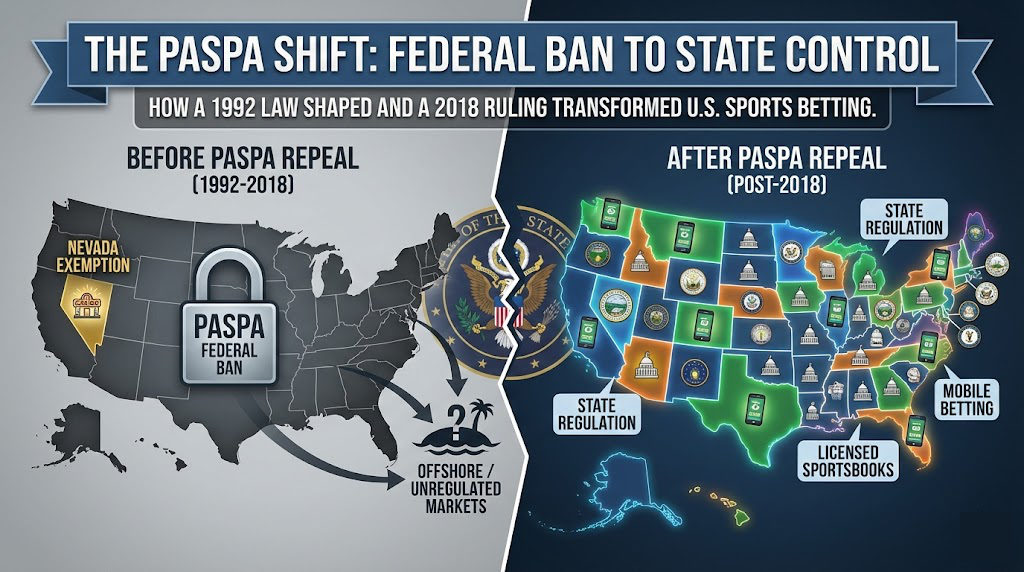
PASPA vs Post-PASPA Sports Betting
Before PASPA ended, legal sportsbooks existed almost exclusively in Nevada. Most bettors turned to offshore sites or local bookies, since there were no regulated options in their home states. There was no oversight, no licensing, and no consumer protection. States were locked out from creating solutions.
Once PASPA was struck down in 2018, everything shifted. States began passing laws to allow sports betting, opening the door for licensed operators and legal apps. This brought tax revenue, player safeguards, and a more transparent industry.
Today’s system isn’t national, but it’s growing. Each state now decides how to handle sports betting and that’s only possible because PASPA is gone.
What PASPA’s Repeal Means Today
Since PASPA was struck down, legal sports betting has expanded rapidly. Dozens of states have passed laws allowing in-person or online betting, and more are considering it each year.
But there’s still no national system. Each state sets its own rules. Some allow mobile betting, others restrict it to casinos, and a few still ban it entirely.
The repeal also didn’t override other federal laws like the Wire Act or UIGEA, which still affect how payments and interstate betting are handled.
Here’s what the post-PASPA landscape looks like now:
- Individual states control whether and how sports betting is allowed
- Regulated sportsbooks operate alongside offshore options in many areas
- Federal laws still shape how betting platforms handle payments and data
- Legal betting markets continue to grow, but remain inconsistent across the country
The end of PASPA shifted power to the states, but it didn’t create a unified system. Bettors still need to understand the rules where they live.
From Ban to Boom: Why PASPA Still Matters
PASPA blocked most states from offering legal sports betting for over 25 years. It didn’t stop people from betting, but it kept the market unregulated and pushed players toward offshore sites.
That changed in 2018, when the Supreme Court struck it down and returned control to the states. Since then, legal sportsbooks have launched across the country, though rules still vary by location.
If you’ve ever wondered why betting laws differ from state to state or why offshore sites are still around, PASPA is the reason. Knowing its story helps you understand where the industry is headed next.
Check out whether sports betting is legal in your area with our state-by-state betting guide.
PASPA and Sports Betting FAQs
What does PASPA stand for?
PASPA stands for the Professional and Amateur Sports Protection Act. It was a federal law passed in 1992 to prevent most states from legalizing sports betting.
Did PASPA make sports betting illegal for everyone?
No. PASPA didn’t ban individuals from betting. It blocked states from passing laws to legalize or regulate sportsbooks.
Why was Nevada allowed to have legal sports betting under PASPA?
Nevada was grandfathered in because it had already legalized sports betting before PASPA passed. A few other states had partial exemptions for limited games.
How did PASPA affect offshore sportsbooks?
PASPA didn’t apply to companies outside the U.S. That helped offshore sportsbooks grow, since states couldn’t offer legal alternatives.
What is Murphy v. NCAA?
It’s the Supreme Court case that struck down PASPA in 2018. The ruling gave states the power to legalize sports betting.
Is there a federal law that controls sports betting now?
No. Each state decides its own sports betting laws. However, federal laws like the Wire Act and UIGEA still apply to payments and interstate activity.